

Ireland combines a 12.5% trading tax rate, an English-speaking common-law system and full access to the EU single market. You don't need to live in Ireland to own an Irish limited company (LTD), but there are a few residency rules you need to plan for before you file. Here's the process from start to finish.
Step 1: Choose your company name
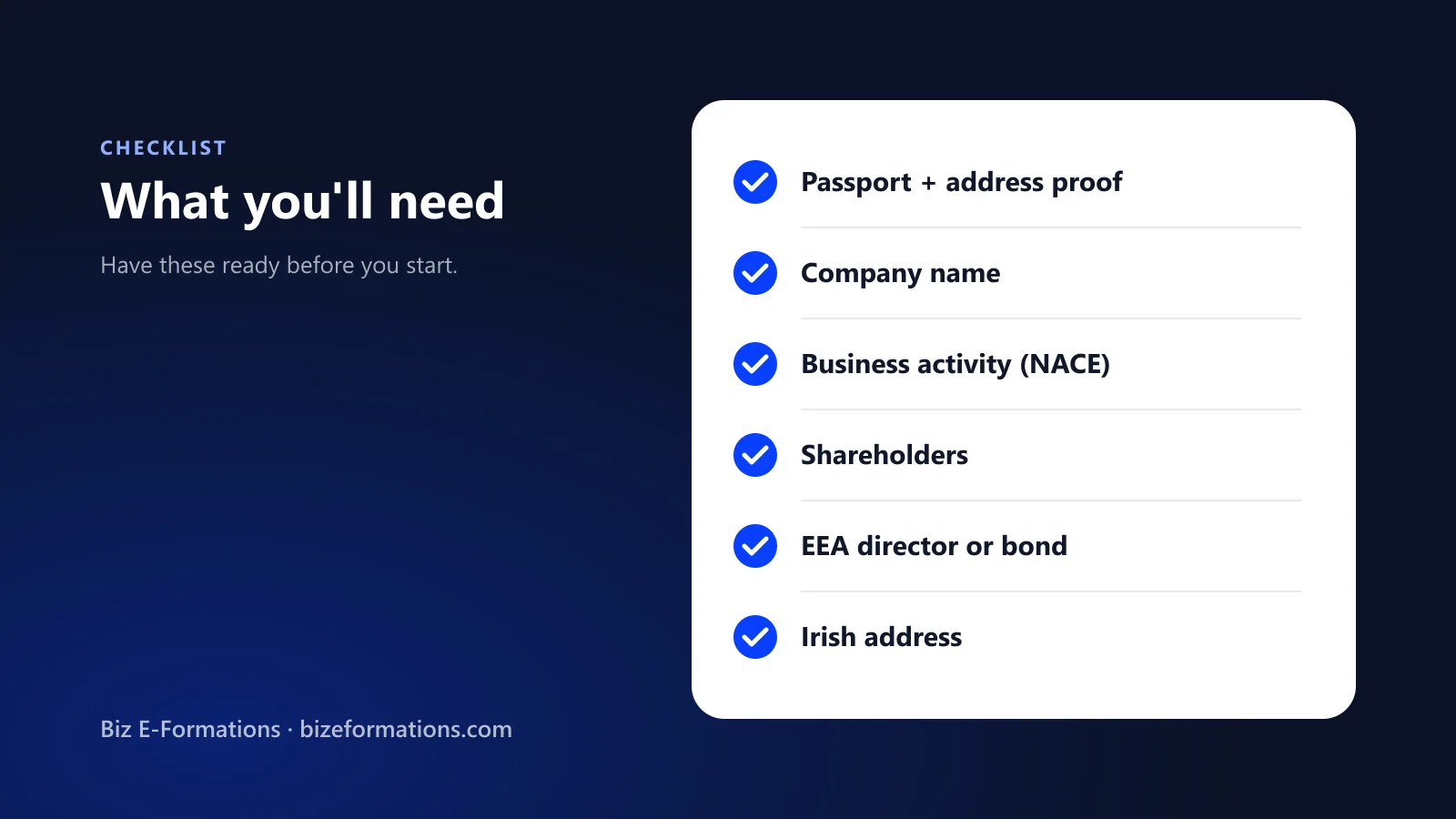
Your name must be unique on the register, not too similar to an existing company, and end in "Limited" or "Ltd" (or the Irish "Teoranta" or "Teo"). It must be entirely in English or entirely in Irish. Some words, such as "Bank", "Group", "Holding", "University" or "Charity", need extra approval. Search the CRO's CORE register before you apply.
Step 2: Get a registered office in Ireland
Every Irish company needs a physical registered office in Ireland, where official post from the Companies Registration Office (CRO) and Revenue is delivered. It's public. If you're abroad, or want to keep your home address private, use a professional address service with mail handling. Our Ireland packages include a Dublin address with yearly pricing.
Step 3: Directors and the EEA residency rule
An Irish LTD needs at least one director aged 18 or over. At least one director must be resident in the European Economic Area (EEA). If none of your directors lives in the EEA, you have two options:
- A Section 137 non-resident bond: an insurance bond (€25,000 cover, renewed every two years) that protects against company law fines.
- A nominee EEA-resident director appointed to the board.
Alternatively, a company can apply to Revenue for a certificate showing it has a real and continuous link to an economic activity in Ireland.
People with an undischarged bankruptcy or a court restriction can't act as directors.
Step 4: Appoint a company secretary
Every company needs a secretary. If you have only one director, the secretary must be a different person. The role can be filled by an individual or a corporate body, and many founders use their formation provider.
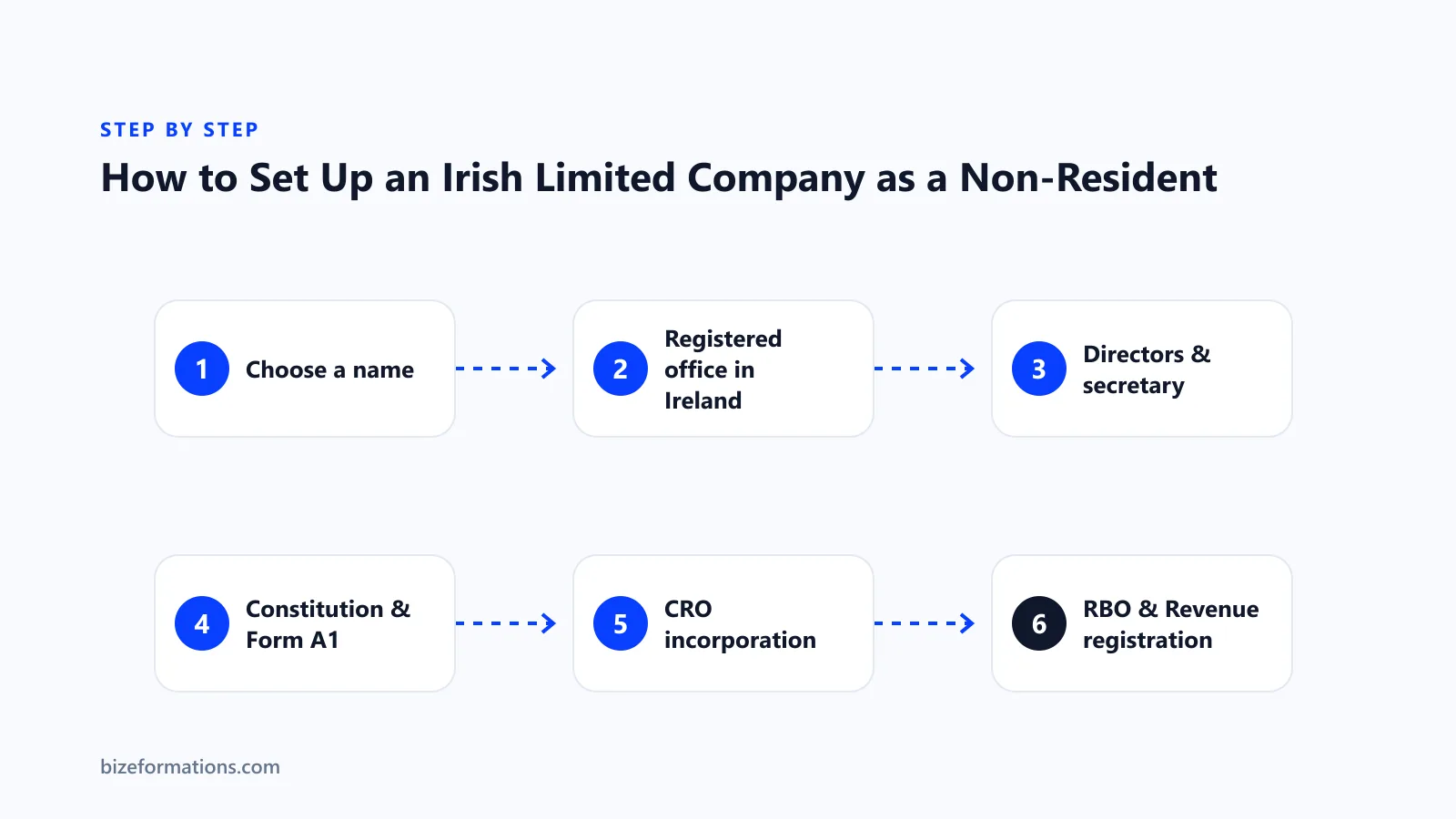
Step 5: Share capital and the constitution
Shareholders adopt a constitution setting out the company's rules and share capital. The minimum issued share capital is just €0.01, and you can authorise more shares than you issue so you can bring in investors later without changing the constitution.
Step 6: File Form A1 with the CRO
Form A1 lists the first directors, secretary, shareholders and registered office, along with the company's activity and NACE code. The CRO will only register a company that shows it intends to carry on an activity in Ireland, so the business description must be accurate. Once approved, you receive a Certificate of Incorporation.
Step 7: Register beneficial owners (RBO)
Within five months of incorporation, the company must register its beneficial owners, meaning people who own or control more than 25%, on the Register of Beneficial Ownership. This needs each owner's PPSN, or a VIF (Verified Identity Number) for people without one.
Step 8: Register for tax with Revenue
Register the company for corporation tax, and for VAT or employer taxes if needed, with Revenue. The 12.5% rate applies to trading income; passive income such as rent or interest is taxed at 25%. Where the company is managed and controlled matters for residency, so take advice if all directors are outside Ireland.
Ongoing compliance
- Annual return (B1) to the CRO every year, usually with financial statements attached.
- Corporation tax return (CT1) to Revenue.
- Keep the RBO up to date when owners change.
- Renew the Section 137 bond every two years if you rely on one.
Common mistakes
- Filing without an EEA director or bond in place.
- A vague business description that doesn't show an Irish activity.
- Missing the five-month RBO deadline.
- Using a home address as the registered office and having it published.
Start your Irish company
See our Ireland company formation packages, priced in US dollars with yearly Dublin address plans, and open an EU-friendly account through our banking partners.
