
A US limited liability company (LLC) is the most popular way for founders outside America to sell to US customers, accept Stripe or PayPal payments and look credible to partners. You don't need a visa, a Social Security Number or to visit the US. This guide walks through the whole process in the order you'll actually do it, with the costs and deadlines that matter.
What an LLC is, and why non-residents choose it
An LLC is a separate legal entity owned by one or more members. It protects your personal assets from the company's debts, and by default the IRS doesn't tax the LLC itself. A single-member LLC is a "disregarded entity", so profits are reported by the owner. For many non-residents with no US office, staff or other "effectively connected" activity, that can mean no US federal income tax, though you still have filing duties (more on that below).
Compared with a C-Corporation, an LLC is cheaper to run, has fewer formalities and is easier to manage from abroad. Choose a C-Corp instead if you plan to raise venture capital or issue stock options.
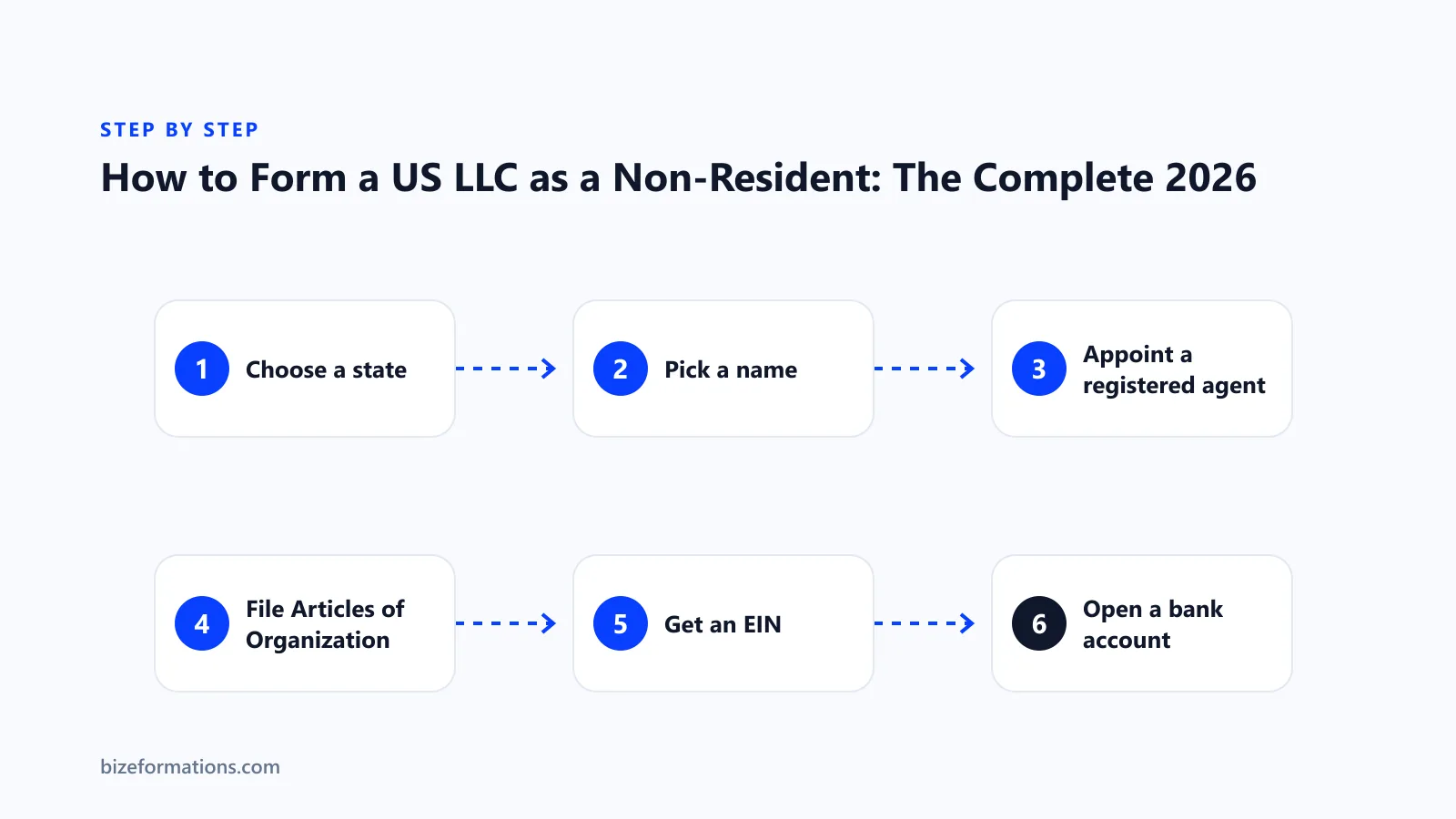
Step 1: Choose the right state
You can form an LLC in any of the 50 states, regardless of where you live. For a business run online from abroad, four states come up again and again:
| State | Filing fee | Yearly cost | Best for |
|---|---|---|---|
| Wyoming | $100 | $60 minimum annual report | Low cost, strong privacy, simple compliance |
| Delaware | $110 | $300 franchise tax | Investor familiarity, Court of Chancery |
| Florida | $125 | $138.75 annual report | Founders who want a well-known, business-friendly state |
| New Mexico | $50 | No annual report | The lowest running cost |
State fees change, so always check the Secretary of State's website before filing. If you will have a physical presence, staff or inventory in one particular state, you will usually need to register there anyway, so it often makes sense to form there directly.
Step 2: Choose and check your company name
Your name must be distinguishable from every other entity on that state's register and must end with "LLC", "L.L.C." or "Limited Liability Company". Search the state's business database before you pay. It's worth also checking that the matching domain name and social handles are free, and searching the USPTO trademark database so you don't build a brand on a name someone else owns.
Step 3: Appoint a registered agent
Every LLC must have a registered agent: a person or company with a physical street address in the state of formation who is available during business hours to accept legal papers and official state mail. As a non-resident you can't be your own agent, so you'll use a commercial registered agent. Read our guide on what a registered agent does to understand why the choice matters.
Step 4: File your Articles of Organization
The state calls this document the Articles of Organization (some states say "Certificate of Formation"). It usually lists the LLC's name, registered agent, principal address, whether it is member-managed or manager-managed, and an organizer who signs it. Most states approve online filings within one to five business days; expedited service is often available for an extra fee.
Once approved you receive stamped Articles. Keep them safe, because banks and payment platforms will ask for them.
Step 5: Sign an operating agreement
An operating agreement sets out who owns the LLC, how profits are split, who makes decisions and what happens if a member leaves. Not every state requires one, but banks almost always ask for it, and it proves the LLC is separate from you personally. Even single-member LLCs should have one.
Step 6: Get an EIN from the IRS
An Employer Identification Number (EIN) is your LLC's federal tax ID. You need it to open a US bank account, connect Stripe or file returns. Non-residents without an SSN or ITIN can't use the online application, so the SS-4 is submitted by fax or mail, or by phone through the IRS international line. Our EIN without an SSN guide explains each option in detail.
Step 7: Open a business bank account
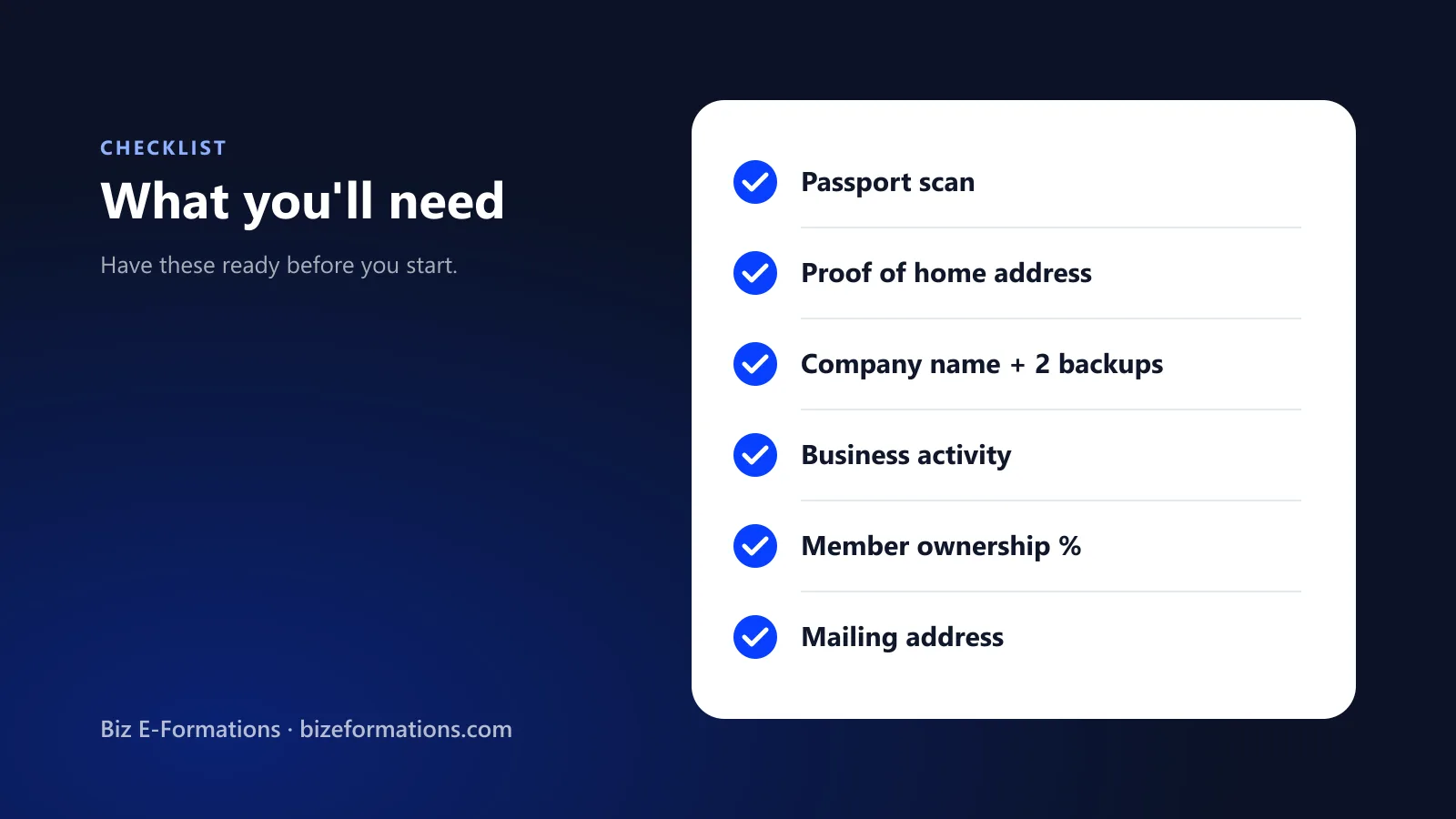
With your Articles, operating agreement, EIN letter and passport you can apply to online-first banks and fintechs that accept non-resident owners. Approval depends on your business model, country and documents. See our banking partners for accounts that work for foreign-owned LLCs, and have a clear website and business description ready, as these are the most common reasons for delays.
Step 8: Stay compliant every year
Forming the company is the easy part; missing yearly filings is where non-residents get caught out.
- State annual report or franchise tax: Wyoming, Delaware and Florida all have yearly filings with fixed deadlines. Missing them leads to penalties and eventually administrative dissolution.
- Form 5472 with a pro forma 1120: a foreign-owned single-member LLC must file these with the IRS every year, even with zero income. The penalty for not filing starts at $25,000. The IRS Form 5472 page explains who must file.
- Registered agent renewal: keep it active, or you'll stop receiving official notices.
- Beneficial ownership (BOI): under FinCEN's March 2025 interim final rule, companies formed in the US are currently exempt from BOI reporting. Rules can change, so check FinCEN's BOI page each year.
Our IRS & State Filing service handles these for you and puts every deadline in your client portal.
Common mistakes to avoid
- Choosing Delaware by default. It's excellent for venture-backed startups, but the $300 yearly franchise tax adds up for a small online business.
- Using a virtual address as the registered agent address. The agent must be a real, staffed address in the state.
- Mixing personal and business money. Run everything through the LLC's own account to keep your liability protection.
- Ignoring Form 5472. "No income" does not mean "no filing".
- Applying for a bank account with a thin website. Banks want to see what you sell, to whom and how.
How long does it take?
A typical timeline is one to five business days for state approval, then one to four weeks for an EIN depending on the method, then a few days to a few weeks for banking. With everything prepared correctly, most founders are trading within a month.
Get it done for you
Our US LLC packages include the state filing, a registered agent for a year, a US business address, the EIN application and banking introductions, so you can focus on your business while we handle the paperwork.
