
A US business bank account makes everything easier for a company owned from abroad: you can receive US dollar payments by ACH and wire, pay US suppliers, connect payment platforms and look established to customers. The question most non-residents ask is simple: can I open one without moving to the United States, and which bank should I choose?
The short answer is yes, in many cases, but the details matter. Traditional banks and online banks make different decisions about foreign owners, and the quality of your application affects the result more than your passport does. This guide explains your options, what to prepare, how the process works and what to do if you are refused.
As always, banks make their own decisions and change their policies. We describe how the process usually works so you can prepare well; we cannot promise any particular approval.
First, what kind of account do you need?
"Bank account" can mean several different things. Decide which of these you need before you apply:
- A traditional bank account at a branch-based bank. Often needs a visit in person and sometimes a US presence. Strongest for cash handling and local relationships.
- An online business bank account at a US fintech. Opened entirely online, often friendly to foreign-owned LLCs, usually backed by partner banks.
- A multi-currency account. Platforms such as Wise Business give you account details in several currencies and are excellent for receiving and sending money internationally.
- A payment platform account. Stripe, PayPal and Payoneer are not banks but are how many businesses actually get paid. See our guide on opening PayPal, Stripe, Wise and Payoneer as a non-US resident.
Many owners use a combination: an online business account for day-to-day operations, a multi-currency account for international transfers and a payment platform for card payments.
What banks look for in a foreign-owned LLC
Banks are legally required to know who owns and controls every company they serve. For a non-resident owner they typically want to see five things:
- A properly formed US company. Your LLC in good standing, with its formation documents.
- A US tax identification number. The EIN issued to the company.
- Who owns it. Normally the operating agreement and your passport.
- What it does. A clear description of the business and where its money comes from.
- A real business footprint. A website, an address, contact details and, ideally, some evidence of customers or a product.
If your company has an EIN and a clear story, you are already ahead of many applicants. If you do not yet have these, start with forming a US LLC and getting your EIN.
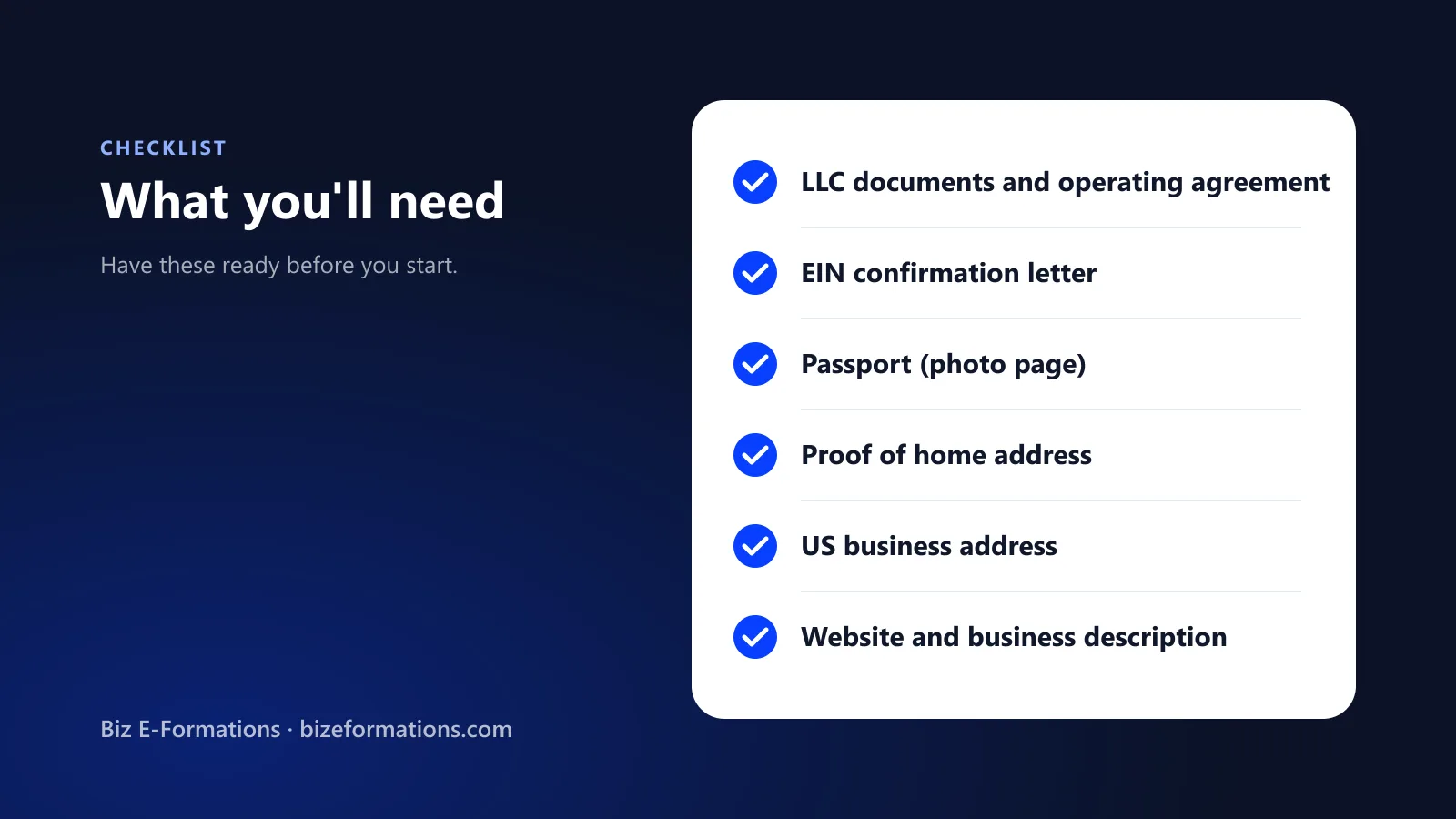
Documents to prepare
| Document | Why it is needed | Tips |
|---|---|---|
| Articles or certificate of organization | Proves the company exists | Use the certified or state-issued copy, not a draft |
| Operating agreement | Shows owners and control | Make sure the ownership percentages match your application |
| EIN letter from the IRS | Identifies the company for tax | Name must match the company name exactly |
| Passport of each owner | Identity of beneficial owners | Photo page, all corners visible, not expired |
| Proof of home address | Confirms where you live | Utility bill or bank statement from the last three months |
| Proof of business address | Confirms the company has a presence | Mail-handling agreement or utility bill in the company name |
| Website or business description | Explains what you do | Keep it consistent with the application text |
The main options, compared
Different providers suit different owners. The table below describes categories rather than promises, because policies change often:
| Option | Opening | Good for | Watch out for |
|---|---|---|---|
| US online business banks (for example Mercury, Brex, Slash) | Fully online | Startups, agencies, software and e-commerce, foreign founders | They are not branches; cash deposits are limited |
| Traditional US banks (for example U.S. Bank, Capital One) | Online or in a branch, depending on the bank and your profile | Owners who want a full-service bank and a local relationship | Stricter checks for foreign owners; documents may need to be certified |
| Multi-currency platforms (for example Wise Business, Airwallex, Revolut Business) | Fully online | International transfers and holding many currencies | Check which currencies and features are available for a US company |
| Payoneer | Fully online | Marketplace and client payouts | Withdrawal and conversion fees |
Our partner list includes banks and platforms that work with foreign-owned companies, and we update it as providers change their rules. See the full list on our bank and merchant accounts page.
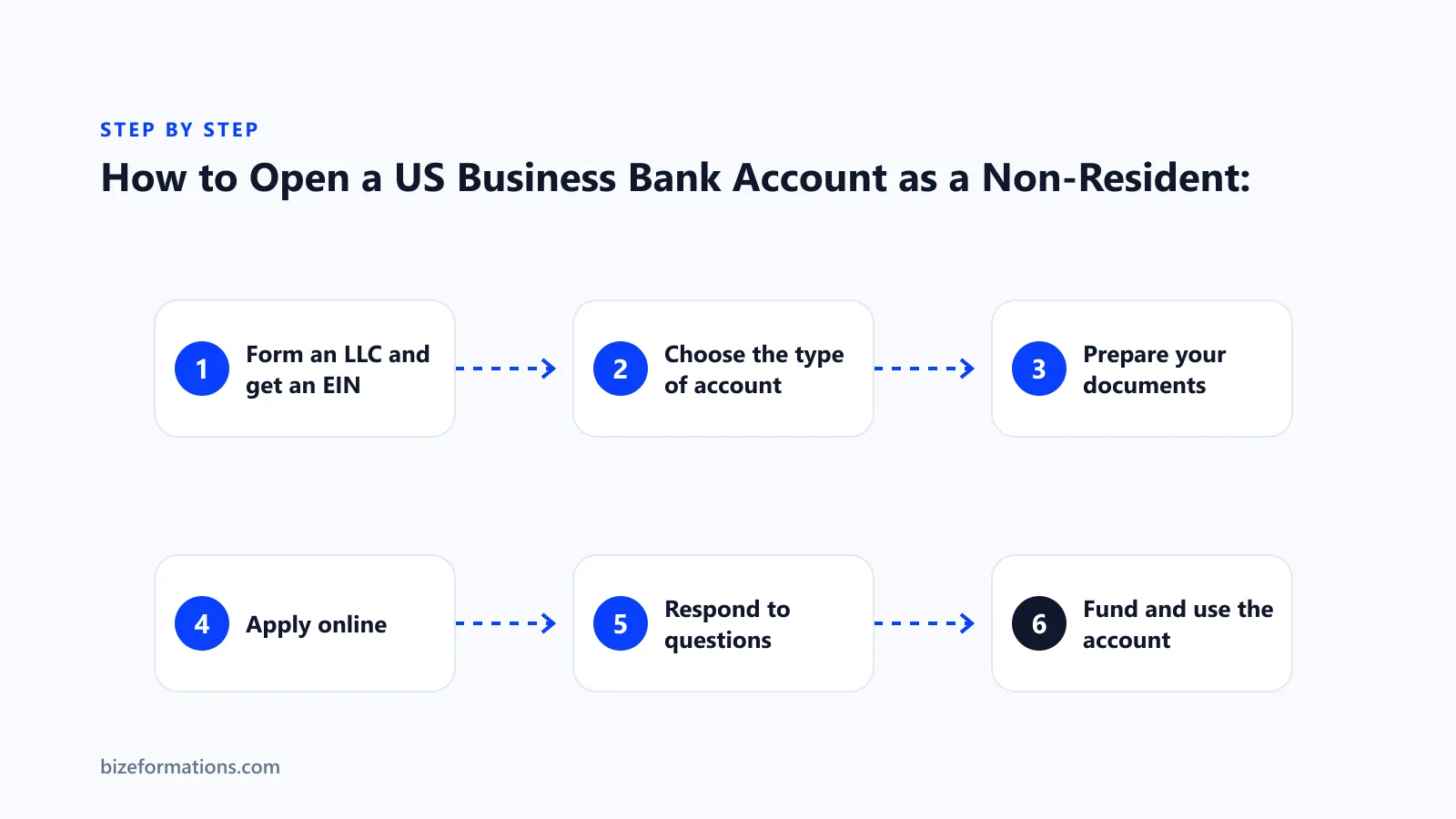
How to apply, step by step
Step 1: Get your foundation right
Make sure the LLC is active, the EIN has been issued and the company details are the same on every document. This is the single biggest factor in approval.
Step 2: Choose the provider
Pick based on what you need: a debit card, international transfers, ACH and wires, integrations with accounting software, low fees. If you are unsure, an online business bank plus a multi-currency account is a strong default.
Step 3: Prepare a short business story
Write two or three sentences: what you sell, who your customers are, where they are located and how they pay. Banks read this to judge risk. Specific is better: "We build and sell Shopify themes to merchants in North America and Europe, paid by card through Stripe" is clear and believable.
Step 4: Submit the application
Complete the online form, upload your documents and verify each owner's identity. Use a good camera in even light for passport photos and selfies.
Step 5: Answer follow-up questions
Do not be alarmed if the bank asks questions. It is normal for foreign-owned companies. Respond fully and quickly, attach invoices, contracts or website screenshots if asked and keep your answers consistent with the application.
Step 6: Fund and use the account
Once approved, fund the account with a first transfer from your own funds or from a customer. Keep a record of the source of money. Regular, explainable activity builds a good history.
Physical debit cards and mail
Many non-residents specifically want a physical debit card. Most US online business banks issue a physical card, mailed to the business address you provide, and virtual cards you can use immediately. Because a card has to be delivered, the address matters. A real address that can receive and forward your mail is far safer than one that cannot; our US Unique Physical Address plan is designed for exactly this situation.
Why applications fail
Understanding the common reasons helps you avoid them. These are the patterns we see most often:
- Mismatched information. Different company names, owner names or addresses on the form and documents.
- Mailbox-type address. A shared virtual address flagged as a mailbox, or an address that does not match the company.
- Unclear business model. A vague description such as "consulting" or "e-commerce" with no specifics.
- No online presence. No website, or a placeholder page.
- Sector or country risk. Businesses in sectors a provider does not support, or owners in countries a provider cannot serve.
- Weak identity photos. Blurry passport pages, cut-off corners or poor selfies.
- Applying too often. Several refusals in a short time make the next application look riskier.
What to do if you are rejected
- Read the message. Many providers state the reason or at least the category.
- Fix the cause. Correct mismatches, improve the website, replace unclear photos or switch to a unique physical address.
- Ask politely for a review if the provider allows it, with a short explanation and the corrected documents.
- Wait before reapplying. A week or two of preparation beats three rushed applications.
- Try a different type of provider. If a traditional bank says no, an online business bank or multi-currency account may say yes, and vice versa.
Country-specific notes for owners abroad
People ask us about this from many countries. The core steps are the same, but a few practical points differ:
- Proof of address. Utility bills and bank statements are accepted in most cases, but formats vary by country. If yours is in a language other than English, a clear translation may help.
- Time zones and verification calls. Some providers call or email. Use a phone number and email you actually monitor.
- Source of funds. Be ready to explain how the account will be funded, particularly for larger first deposits.
- Currency. Receiving US dollars into a US account and then converting is often cheaper than having customers pay in your local currency, but compare your actual costs.
Staying in good standing after you open the account
- Keep business and personal money separate and pay yourself with clear transfers.
- Keep invoices and contracts for larger payments.
- Update the bank if your address, phone or ownership changes.
- File your IRS and state requirements on time. If your LLC is foreign-owned you may need Form 5472; see our IRS and state filing service.
- Keep your registered agent and annual report current.
How Biz E-Formations helps
- We form your LLC, get your EIN and set up your registered agent and business address.
- We prepare a consistent document pack and a clear business description for each application.
- We introduce you to banks and platforms that work with foreign-owned companies and help with the application.
- We can provide a unique physical US address for card delivery and verification.
Approval is always the provider's decision. Our job is to make your application as clear and complete as possible.
Traditional banks and online banks: the trade-offs in detail
The choice between a traditional bank and an online business bank is not only about whether you can open the account remotely. It affects what you can do with it day to day.
Online business banks
These providers are built around software. Opening is quick, the interface is modern and features such as virtual cards, team permissions, invoicing and accounting integrations are common. Because many are not banks themselves, your deposits are held at one or more partner banks; each provider explains this in its disclosures, including how deposit insurance works. For most internet businesses owned from abroad, this is the most practical starting point.
Traditional banks
Branch-based banks offer a wider range of services, such as cash handling, lending, merchant services and in-person support. For a foreign-owned company they can also ask for more documentation, sometimes certified or apostilled, and some prefer to meet the owner. If you expect to need credit, large cash deposits or a long-term banking relationship, the extra effort may be worth it.
Multi-currency platforms
These sit alongside either option. They are excellent for receiving payments in several currencies and sending money abroad at transparent fees, and many foreign owners keep one even if they also have a US bank account.
Beneficial ownership and KYC, in plain language
Banks follow "know your customer" rules. For a company, that means identifying the people behind it. In the US, banks collect details about individuals who own a significant share of the company (commonly 25 percent or more) and about one person with significant control of it. If your LLC has a single owner, that is you. If it has several, each significant owner will be asked for identification.
What this means for you in practice:
- List every owner above the threshold, with their full legal names and ownership percentages, in the same way in the application and the operating agreement.
- Be ready to provide a passport and proof of address for each of them.
- Expect questions if the ownership is held through another company; you may need to provide that company's documents too.
How to explain your source of funds
Banks want to understand where the money comes from. A short, honest explanation is enough, and it should match what the account will actually do.
- Customer revenue. "The company receives card payments through Stripe from customers who buy our software subscriptions."
- Client invoices. "We invoice agencies in the US and Europe for design work, paid by bank transfer."
- Marketplace payouts. "We sell physical products on a major marketplace and receive payouts weekly."
- Owner funding. "I will fund the account with savings from my salary as the founder."
Keep supporting evidence ready, such as invoices, a marketplace seller account screenshot or a savings statement. Never exaggerate expected volume; a modest, truthful forecast is safer than an impressive number you cannot support.
Three example banking setups
| Business | Suggested setup | Why |
|---|---|---|
| Freelance developer paid by overseas clients | Multi-currency account plus an online business bank | Receive transfers cheaply and pay US software bills in dollars |
| E-commerce store selling to US customers | Online business bank, Stripe and PayPal, plus Wise or Payoneer for payouts | Card payments, a US dollar account for suppliers and flexible withdrawals |
| Small agency with a team | Online business bank with team cards, plus a traditional bank later if needed | Spend controls and accounting integrations now, extra services as it grows |
Practical questions people ask
How long does opening take?
Online providers can approve within a day or two when documents are clear, though extra review can take longer. Traditional banks usually take longer, especially if documents need certification.
What do accounts cost?
Fees vary widely. Many online business accounts have no monthly fee for basic use, while traditional banks often charge monthly fees unless you keep a minimum balance. Wire fees, international transfer fees and card fees differ, so read the current fee schedule before you choose.
Is my money insured?
Deposit insurance in the US applies to deposits at insured banks up to set limits. Online providers that use partner banks explain how coverage works in their documentation. Read it, and consider spreading large balances across providers.
Which payment methods will I have?
Most accounts support ACH transfers, domestic wires and debit cards, and many support international wires. Check the exact list and the fees for the methods you will use most.
Can I open more than one account?
Yes. Many owners keep one account for operations, another for taxes or savings and a separate currency account for international payments.
Mistakes we see most often
- Applying before the EIN letter has arrived, so the application has no tax ID to match.
- Using a personal address in the business address field and a business address in the personal field.
- Describing the business differently on the website, the application and the call.
- Sending the first large deposit from an unrelated third party with no explanation.
- Letting the account sit unused for months, which can lead to questions or closure.
- Ignoring emails from the bank asking for a document, then being surprised when the account is restricted.
A simple timeline from zero to a working account
| Week | What happens |
|---|---|
| 1 | Form the LLC and request the EIN; set up your registered agent and business address |
| 2 | Receive formation documents; prepare the document pack and business description |
| 2 to 3 | Apply to an online business bank and a multi-currency account |
| 3 to 4 | Answer any questions, receive cards and account details, send a first transfer |
| 4 onwards | Connect payment platforms and start receiving payments |
The EIN is often the slowest step for non-residents, so start it as early as possible. Everything else moves quickly once it arrives.
What happens after you apply: the review process
Knowing what goes on behind the scenes makes waiting easier and helps you respond in the right way. Most providers follow a similar path:
- Automated checks. The system verifies your identity documents, compares the company name and tax number with records and screens the people involved against standard watchlists.
- Document review. A person reads your formation documents, operating agreement and business description and checks that they agree with each other.
- Risk review. The provider considers the type of business, the countries involved and the expected activity. Higher-risk profiles get closer attention.
- Follow-up questions. If something is unclear, you receive an email or a message in your account. This is common for foreign-owned companies and is not a refusal.
- Decision. You are approved, asked for more information or declined. Many providers do not explain a decline in detail, so the quality of your first application matters.
The best response to a follow-up question is a short, direct answer with a document attached. Avoid long stories. If the question mentions something that is not on your application, check whether a mismatch caused it.
Business descriptions that work
A clear description is one of the easiest ways to improve your chances. Here are five examples in plain language that you can adapt to your own business:
- Software. "We sell a subscription web application for scheduling to small clinics in the United States. Customers pay monthly by card through Stripe."
- Agency. "We provide marketing and design services to small businesses in North America and Europe. We invoice monthly and clients pay by bank transfer."
- E-commerce. "We sell home accessories to customers in the United States through our own online store and a major marketplace. Products ship from our supplier."
- Digital products. "We sell templates and online courses to customers worldwide. Payments are taken by card and PayPal and paid out weekly."
- Consulting. "We provide consulting on supply chain planning to mid-sized manufacturers in the United States. Clients pay by bank transfer after invoices."
Notice what each example includes: what is sold, to whom, where and how it is paid. Use the same wording on your website so every source tells the same story.
Protecting the account once it is open
- Turn on two-step sign-in with an authenticator app rather than text messages where possible.
- Use a unique password stored in a password manager.
- Set alerts for transfers, card use and logins so you notice anything unusual quickly.
- Limit access. Give team members only the permissions they need, and remove access when someone leaves.
- Be careful with email. Fraudsters often impersonate banks. Go to the provider site or app directly instead of using links in messages.
- Keep your contact details current so verification messages reach you.
Conclusion
Opening a US business bank account as a non-resident is realistic. The path is: form the LLC, get the EIN, pick the right type of account, prepare consistent documents and a clear business story, and apply online. If one provider says no, learn why, fix it and try another type. Most successful applicants are not special; they are simply well prepared.
Get in touch
Need help choosing a provider or preparing your documents? Contact our team, chat with Biz AI on this page, or book a free 30-minute consultation.
