
If you live outside the United States and want to sell to American customers, the first problem is rarely the product. It is getting paid. PayPal, Stripe, Wise and Payoneer are the four platforms most international founders use to receive money from the US, but each has its own rules about who can open an account, which documents it wants and why it sometimes says no.
This guide explains how the four platforms work for a non-US resident, what a US company changes, the exact order we recommend for opening the accounts, the reasons applications are rejected and how to avoid them. It is written for freelancers, e-commerce sellers, software and service businesses and agencies who own a business from abroad.
A quick honest note before we start: every platform makes its own approval decisions and changes its rules from time to time. Nothing here is a guarantee of approval. What we can do is show you what a strong, consistent application looks like, because most rejections come from preventable mismatches rather than from your nationality.
Why a non-US resident needs a US company to receive US payments
Technically, you can open personal accounts on some of these platforms from your own country. The trouble starts when you want to accept card payments from US customers, receive marketplace payouts in US dollars, pay US suppliers or look professional to American clients. Personal accounts in your home country usually mean currency conversion fees, slower payouts, limits on the type of business you can run and, with some platforms, no access to US features at all.
A US limited liability company changes this in four ways:
- It is a US legal entity. Platforms can onboard it under US rules rather than treating you as a foreign individual.
- It has a US tax number. The EIN issued by the IRS is the ID almost every platform asks for.
- It has a US business address and, usually, a US bank or bank-like account. That makes receiving USD payments simple.
- It separates your business from you personally. Money, contracts and liability sit in the company.
If you do not yet have a company, start with our guide on how to form a US LLC as a non-resident and then get an EIN without an SSN. Once you have both, the rest of this guide applies directly.
The four platforms at a glance
| Platform | Best for | What it does | Typical first requirement |
|---|---|---|---|
| Wise Business | Holding and sending money, receiving USD by bank transfer | Local account details in several currencies, low-cost transfers, debit card | Company documents and identity checks for owners and directors |
| Payoneer | Marketplace and client payouts | Receiving accounts that let you be paid like a local, withdrawals to your own bank | Company documents and a clear description of your business |
| Stripe | Accepting card payments on your website or app | Payment processing, subscriptions, invoices, payouts to a bank account | EIN, company details, representative identity, a bank account for payouts |
| PayPal Business | Customers who prefer PayPal, invoices, quick checkout | Accepting PayPal and card payments, sending payouts | EIN, business address, a linked bank account |
Notice that Stripe and PayPal want a bank account to send your money to, while Wise and Payoneer can act as that destination. That is why the order in which you open them matters.
The recommended order (and why it works)
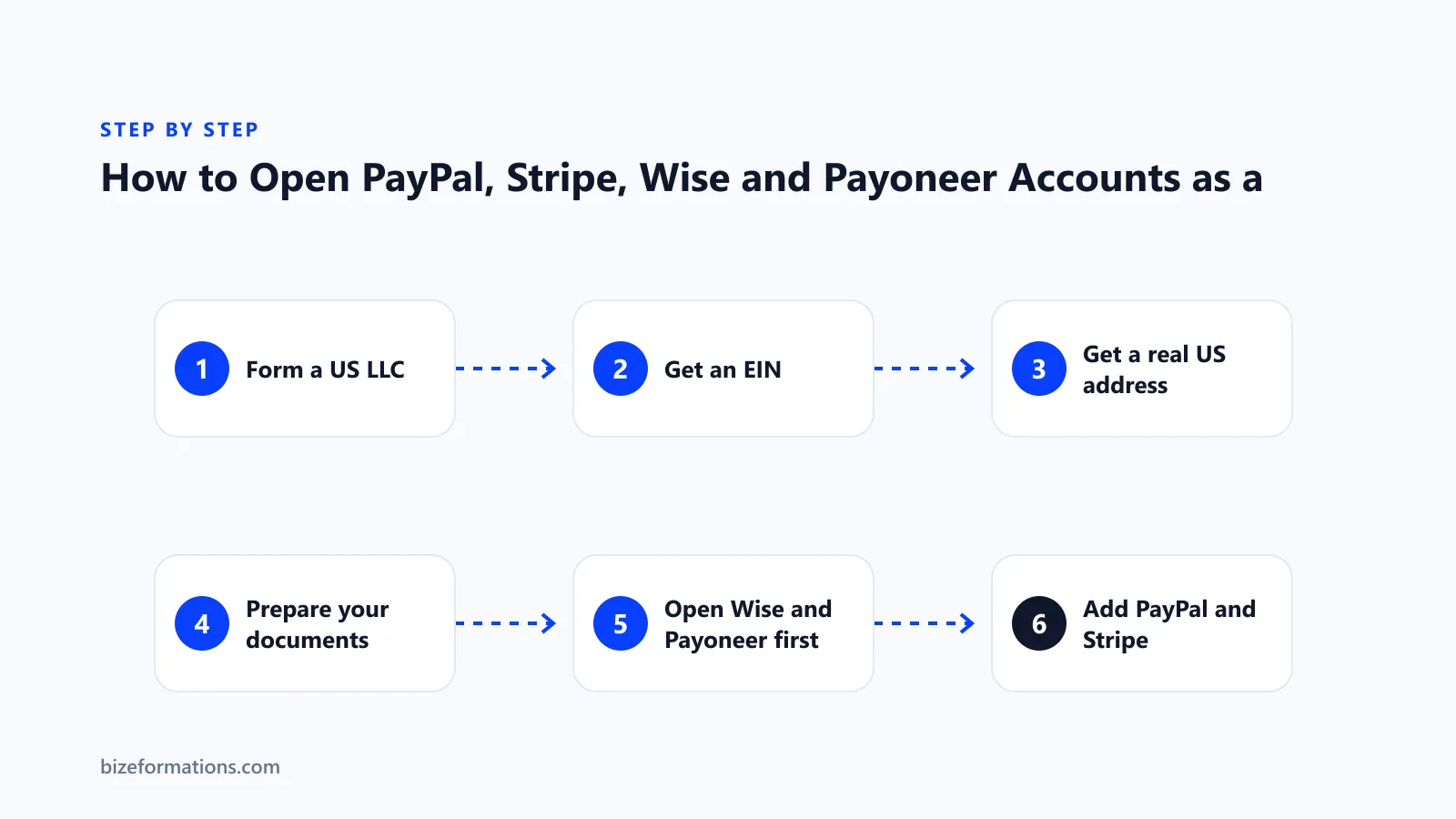
- Form the LLC and get the EIN. Nothing else is reliable without these two.
- Set up a real US address and phone number. Use an address that can receive mail in your company's name, not an anonymous drop. We explain why below.
- Open Wise Business. It gives you USD bank details that are accepted as a payout destination almost everywhere.
- Open Payoneer. This is your second receiving route, especially useful for marketplace and client payouts.
- Add Stripe. Link it to the Wise or other US-dollar account you already have.
- Add PayPal Business. Link it to the same destination account and verify your business details.
Why this order? Because a platform that is asked to send money to an account in the company's own name, with consistent details, trusts the application more than one that points to an unrelated personal account in another country. Opening the receiving accounts first makes every later application easier.
Before you apply: get your details consistent
The single most common reason an application is refused or an account is later limited is inconsistency. Compliance teams compare what you type with your documents and with public records. Spend an hour on this before you open anything:
- Company name. Exactly as on your formation documents, including the LLC suffix. Do not shorten it or add a brand name in the legal-name field.
- Owner name. Exactly as on your passport. If your passport has a middle name, decide once whether you include it and keep it the same everywhere.
- Address. The same US business address everywhere, written the same way. Your personal home address is separate and should match your proof of address.
- Business description. One clear sentence: what you sell, to whom, and how customers pay. Platforms read this carefully.
- Website or listing. A real page that matches your description, with contact details, pricing and terms. A "coming soon" page invites questions.
- Email and phone. A business email on your own domain looks more credible than a free webmail address, and a reachable phone number helps verification.
Documents you will be asked for
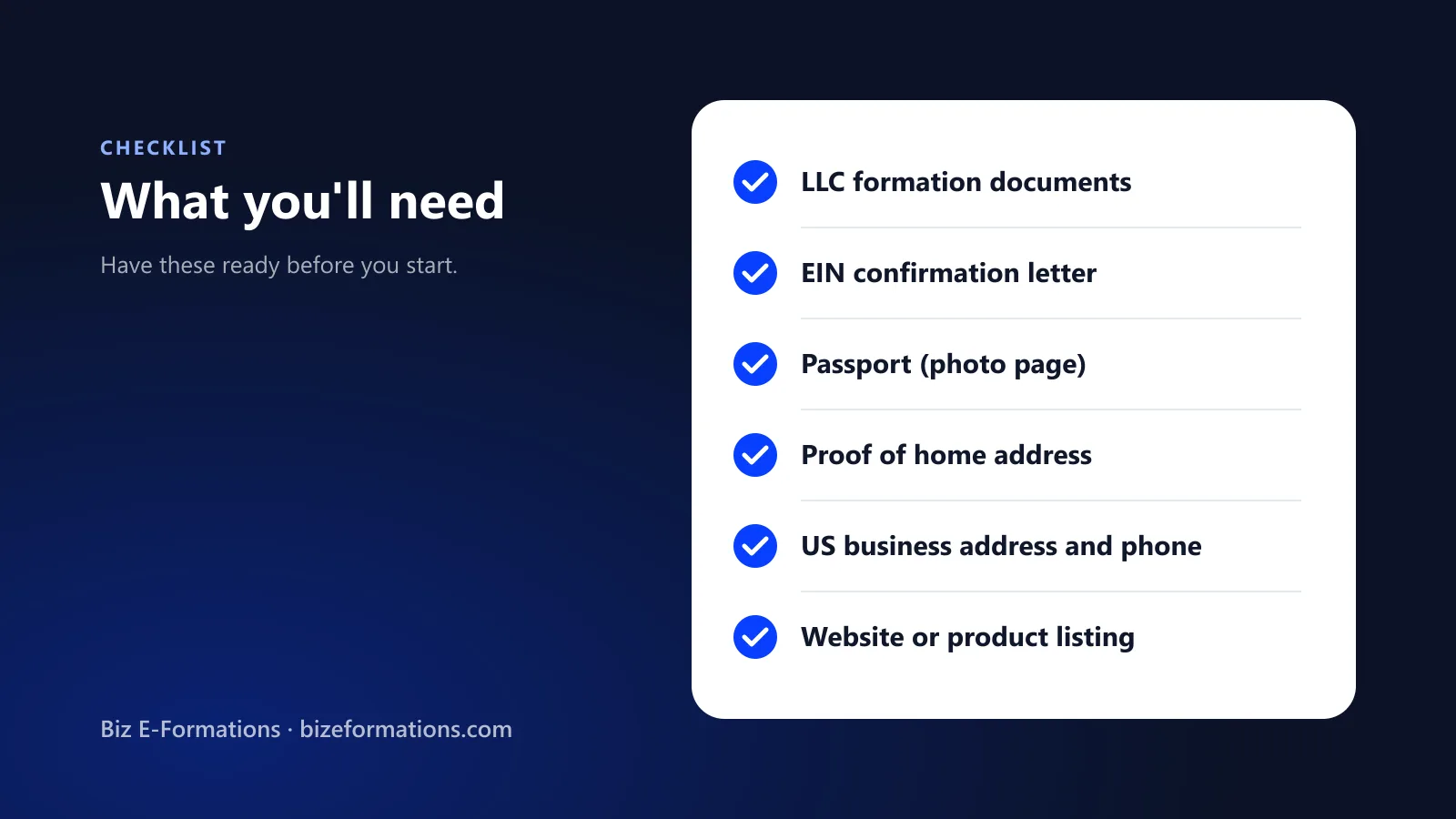
Nearly every platform asks for some combination of the following. Having them ready as clear PDFs or photos speeds everything up:
- Certificate or articles of organization for the LLC.
- The IRS letter confirming your EIN (CP 575 or the replacement confirmation letter).
- A passport photo page for each owner or director, with all four corners visible.
- Proof of home address from the last three months, such as a utility bill or bank statement.
- The LLC operating agreement, which shows who owns the company.
- Proof of the business address, such as a mail-scanning agreement or a utility bill in the company name.
Wise Business for a US LLC owned from abroad
Wise Business is often the easiest first step because it is built for international users. You can hold balances in many currencies, get account details that let others pay you by local bank transfer and send money abroad at a clearly shown fee.
How to apply
- Choose a business account and select the United States as the country of registration.
- Enter the company details exactly as on the formation documents and the EIN.
- Add the owners and directors and complete the identity checks, usually a passport photo and a selfie.
- Upload any documents requested and wait for the review.
What helps
- A clear explanation of the business model and the countries of your customers.
- Consistent details across the application and the documents.
- A genuine business website.
What to watch
Wise may ask follow-up questions about where your money comes from and where it goes. Answer plainly and attach invoices or contracts if you have them. Once approved you can request USD account details and use them as the payout destination for Stripe, PayPal and many marketplaces.
Payoneer for a US LLC owned from abroad
Payoneer is widely used for marketplace payouts and client payments. A business account lets you receive money into local-style accounts, hold balances and withdraw to your own bank account.
How to apply
- Create a business account and select the company type that matches an LLC.
- Enter company details, the EIN, the business address and a short description of your activity.
- Add the people who own and control the company and verify their identities.
- Upload the formation documents and any other items Payoneer asks for.
Making the description count
Payoneer reviewers want to understand what you sell and who pays you. "Software development services for clients in the United States, paid by bank transfer and card" is better than "online business". If you sell through a marketplace, say which one and, where relevant, how long you have been selling.
Using it well afterwards
Once you have receiving accounts, you can point marketplace payouts or client invoices to them. Withdrawing to your own bank account has fees and exchange rates that you should compare with other routes, so check current pricing in your account before you move large amounts.
Stripe for a US LLC owned from abroad
Stripe is the standard way to accept card payments on a website or app. Stripe supports businesses based in specific countries. If your own country is not on the list, a US company can open a US Stripe account, which is one of the most common reasons founders form an LLC.
What Stripe asks for
- The legal business name, EIN, business address, website and a description of what you sell.
- Details and identity verification for the representative and, for larger owners, for each person who owns a significant share of the company.
- A bank account to receive payouts. A US-dollar account in the company name, such as the one you opened earlier, is ideal.
Making Stripe approve you
- Show what you sell. Add pricing, product descriptions, refund and shipping policies and contact details to your website before applying.
- Match your descriptor. The name customers see on their statements should resemble your website and company.
- Be accurate about restricted activities. Stripe has a list of businesses it does not support. If your activity is close to that list, read the policy first rather than hoping.
- Keep the bank account consistent. The account holder name should match the company.
If Stripe rejects or pauses you
Read the message carefully. It usually names the reason, such as unverified identity, mismatched details or an unsupported business model. Fix what it names, reply once with clear evidence and avoid opening many new accounts in a row. Repeated applications with changing details look like a risk signal. Our guide on why PayPal, Stripe, Wise and Payoneer freeze funds explains what to do if money is held.
PayPal Business for a US LLC owned from abroad
PayPal remains popular with customers who prefer not to enter card details. A business account lets you send invoices, add PayPal at checkout and accept card payments.
How to apply
- Sign up for a business account and choose the US as the country.
- Enter the company information and EIN exactly as on your documents.
- Add and verify a bank account in the company name.
- Complete any identity verification PayPal requests for the owner.
Common mistakes
- Opening a personal account first and then switching it to business with different details.
- Linking a bank account in a different name, or a card in your personal name only.
- Using one email or device for several PayPal accounts. Keep one business account for one business.
- Logging in from many countries in a short time before the account has history.
Protect yourself
PayPal can hold funds on new accounts that suddenly receive large payments. Ramp up gradually, ship and deliver promptly, keep proof of delivery and answer disputes quickly and politely.
Why applications get rejected (and how to avoid each one)
| Reason | What it looks like | How to prevent it |
|---|---|---|
| Name mismatch | Company name differs between the form and the documents | Copy the name from the formation certificate |
| Address problems | Address flagged as a mailbox, or not matching documents | Use a real street address with a unit number that can receive mail in your company name |
| No website evidence | No site, or a site with no prices or contact details | Publish a complete, honest site before applying |
| Vague business description | "Online business" or "consulting" | Describe the product, customer and payment method in one sentence |
| Identity check failure | Blurry passport or a selfie that does not match | Use good light, all four corners visible and a plain background |
| Restricted activity | Business model outside the platform's policy | Read the acceptable use policy before applying |
| Too many applications | Several refusals in a few days | Fix the cause, wait, then apply once more |
The address question, explained simply
A US address is one of the most misunderstood parts of this process. There are three different things people call "an address", and platforms treat them differently:
- Registered agent address. The address of the person or company that receives legal documents for your LLC in its state. It is required for the company, but it is often shared by thousands of companies, so some platforms do not accept it as a place of business.
- Virtual business address. A mail-handling address that scans and forwards your mail. Fine for many uses, but a shared address may be flagged as a mailbox by strict verification.
- Unique physical address. A real street address with your own suite number, used only by you. This is the kind of address that tends to satisfy bank and payment verification best.
If you have been refused because of an address, moving to a unique physical address is often the cleanest fix. We offer exactly this as a US Unique Physical Address plan and as part of our registered agent and business address service.
Keeping the accounts healthy after approval
- Keep records. Save invoices, contracts, shipping proof and customer messages for each large payment.
- Do not mix personal and business money. Pay yourself from the company by a clear transfer, not by random withdrawals.
- Keep your details current. If you change address, phone or ownership, update every platform.
- File your taxes. A US LLC owned by a non-resident still has reporting duties. See our IRS and state filing service and remember Form 5472 where it applies.
- Keep your company active. File the annual report and keep your registered agent current so the company stays in good standing.
Which accounts do you actually need?
You do not have to open all four on day one. A simple rule works for most owners:
- Freelancer or agency paid by bank transfer: Wise plus Payoneer, and PayPal if clients ask for it.
- Online store or digital product: Stripe and PayPal at checkout, with Wise or Payoneer as the payout destination.
- Marketplace seller: Payoneer or Wise for payouts, plus a US business bank account if the marketplace requires one.
- Software or subscription business: Stripe first, then PayPal, with Wise for holding and sending funds.
If you need a physical US bank account with a debit card as well, read our companion guide on opening a US business bank account as a non-resident.
A realistic timeline
| Step | Typical time |
|---|---|
| LLC formation | A few days to about two weeks, depending on the state |
| EIN | From days to a few weeks for non-residents |
| Wise and Payoneer reviews | From minutes to about a week |
| Stripe and PayPal | Often quick, but extra checks can add days |
These are typical ranges, not promises. Slow reviews are usually caused by missing or unclear documents.
How Biz E-Formations helps
- We form your US LLC, obtain your EIN and provide a registered agent and business address.
- We prepare consistent company details and documents so your applications start from a strong position.
- We can set up PayPal, Stripe, Wise and Payoneer for you and keep records of what was submitted.
- We offer a unique physical US address where a platform will not accept a shared one.
Approvals are always decided by each platform. Our role is to give you the cleanest possible application and to help if something needs fixing.
Fees, currencies and cash flow: what to expect
Every platform earns money somewhere, and the cost that surprises people is rarely the headline fee. When you compare setups, look at four separate costs:
- Receiving fees. Some platforms charge a small fee to receive a payment, others do not charge for receiving but take a margin on conversion.
- Processing fees. Stripe and PayPal charge a percentage plus a fixed amount per card payment. The rate can differ by card type, country and payment method.
- Currency conversion. Converting US dollars into your local currency is where a lot of value can quietly leak. Compare the exchange rate you are offered with the mid-market rate, not only the stated fee.
- Withdrawal and transfer fees. Moving money to your own bank account may have a flat fee, a percentage or both.
A practical way to reduce cost is to keep US dollars in a US-dollar account while you have US expenses (software, advertising, suppliers) and convert only the amount you actually need in your home currency. Spend a few minutes comparing the real, all-in cost of one sample payment through each route before you commit your regular payouts to one of them.
Cash flow matters as well. Card payments are usually paid out after a delay that depends on the platform and how established your account is. New accounts often have longer payout schedules and lower limits that relax as you build history. Plan for this by not depending on the first payout to cover an urgent bill.
A worked example
Consider a designer based outside the United States who sells website templates to customers in the US and Europe. Here is how a clean setup might look:
- She forms a US LLC, receives an EIN and uses a unique physical address as the company's business address.
- She opens Wise Business, which gives her USD account details in the company's name.
- She opens Payoneer as a second route, mainly for a marketplace that pays out through it.
- She adds Stripe on her own website for card payments, pointing payouts to the Wise USD details, and adds PayPal as an alternative at checkout.
- Each month she pays herself from the company by a clear transfer and keeps invoices and payout reports for tax time.
Nothing in this setup is exotic. Every account is in the company's name, every address and name matches the formation documents, and the money has a clear path from customer to company to owner.
Tax and record keeping: the basics
Receiving payments into a US company does not remove tax obligations; it makes them clearer. A non-resident-owned LLC usually has to file an annual information return with the IRS and may owe tax depending on how the business is structured and where its income is connected. Because rules are specific to your situation and your home country, speak to a qualified tax adviser, but keep these habits whatever the answer is:
- Keep every invoice, receipt and payout statement for the company, organised by month.
- Record the exchange rate used for conversions.
- Keep a log of money you take out of the company and why.
- Do not use the company account for personal shopping.
Our IRS and state filing service can handle the US filings that apply to foreign-owned LLCs, and good records make that work faster.
Conclusion
Getting paid from the US as a non-resident is a solved problem once you have the right foundation: a US LLC, an EIN, a real address and consistent documents. Open Wise and Payoneer first, then add Stripe and PayPal pointing at accounts in your company's name, describe your business clearly and keep your records tidy. Most of the refusals we see are not about nationality at all; they are about mismatched details and thin evidence, and both are fixable.
Get in touch
Want your accounts set up properly the first time? Contact our team, chat with Biz AI on this page, or book a free 30-minute consultation.
