
Few things stop a business faster than a message saying your PayPal, Stripe, Wise or Payoneer funds are on hold. Money you've already earned is suddenly out of reach. The good news is that most freezes are compliance reviews, not confiscations, and they can be resolved with the right documents and a clear explanation. This guide covers why platforms freeze accounts, the documents each one usually wants, how long holds last, and how problems with your company's legal status, such as being struck off or dissolved, cause freezes that only a company fix can solve.
Why payment platforms freeze funds
Payment companies are regulated financial businesses. They must know who they're dealing with (KYC), understand what you sell, and manage the risk of fraud and refunds. A freeze usually means something triggered a review:
- Identity or KYC gaps: missing or expired ID, a proof of address that doesn't match, or a director the platform can't verify.
- Company status problems: the company is struck off, dissolved, on the Companies House default address, or its directors haven't completed identity verification.
- Unusual activity: a sudden jump in sales, large one-off payments, or money moving out as soon as it comes in.
- High disputes or refunds: chargebacks, customer complaints or delivery problems.
- Business model concerns: selling restricted products, or a website that doesn't clearly show what you sell, your terms and your refund policy.
- Location or sanctions screening: logging in from an unexpected country, or a name match against sanctions lists.
Types of holds
| Type | What it means | How it usually ends |
|---|---|---|
| Payment hold | Individual payments held for a period (often up to 21 days) while orders are fulfilled | Released after delivery is confirmed or the period ends |
| Rolling reserve | A percentage of each payment held for a set time | Released on a schedule; may be reduced after good history |
| Account limitation / review | Withdrawals or payments restricted pending documents | Lifted once the platform accepts your documents |
| Account closure with funds held | The relationship ends; the balance is held for a risk period | Balance released after the period (PayPal commonly up to 180 days), minus disputes |
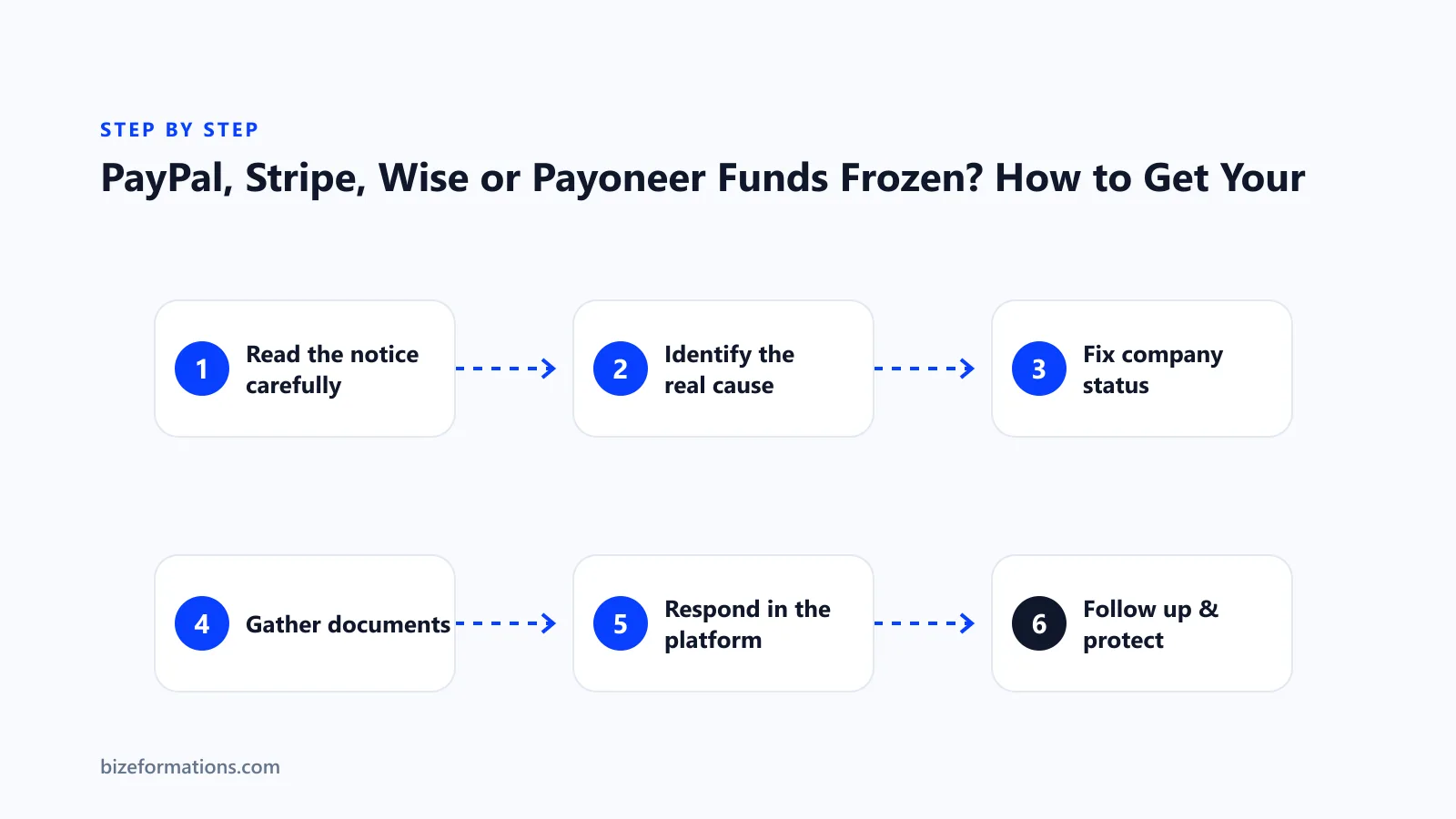
Step 1: Read the notice carefully
The platform's message usually says what it needs, even if briefly. Log in directly (never through a link in an email), open the resolution centre or notifications, and note the exact request and deadline.
Step 2: Identify the real cause
If the request mentions your business documents, check your company's public record first. Search Companies House for a UK company, or the Secretary of State website for a US LLC. Look for:
- status: "Active" or "Dissolved" / "Struck off" / "Administratively dissolved";
- a proposal to strike off notice;
- the registered office address (is it the default address?);
- overdue filings.
If the company is dissolved, no amount of uploading documents will fix the freeze. The company has to be restored first. Our guide on restoring a dissolved company explains how.
Step 3: Fix company status problems
- Strike-off notice: file the overdue accounts or confirmation statement and ask Companies House to suspend the action.
- Default address: move to an appropriate registered office address.
- Unverified directors: complete Companies House identity verification.
- US good standing: file missing annual reports and keep your registered agent active, then request a certificate of good standing.
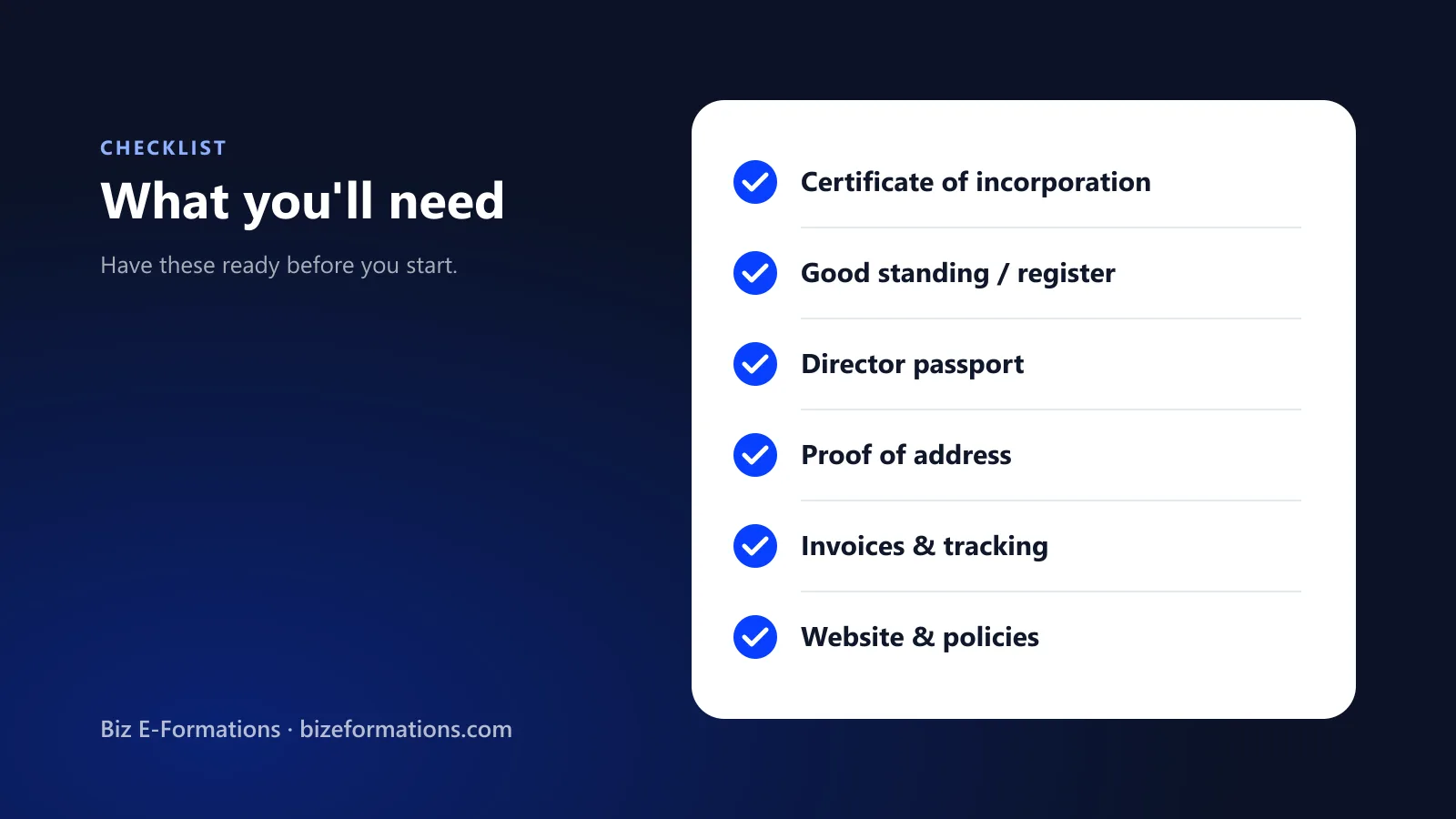
Step 4: Gather the right documents
| Document | Why they ask |
|---|---|
| Certificate of incorporation / Articles | Proves the company exists |
| Good standing certificate or register print-out | Proves it's active and compliant |
| EIN letter or company tax number | Matches tax records |
| Director and owner passport | Identity (KYC) |
| Proof of home address (last 3 months) | Address verification |
| Supplier invoices and shipping tracking | Proves you deliver what you sell |
| Customer contracts or invoices | Explains large or unusual payments |
| Website with terms, refund policy and contact details | Shows a legitimate business |
Send clear colour scans or PDFs, all corners visible, with names that match exactly across every document.
Step 5: Respond platform by platform
PayPal
Use the Resolution Center to upload documents. For holds on individual payments, adding tracking numbers often releases funds faster. If PayPal limits or closes the account, the balance is commonly held for up to 180 days to cover disputes, then released. See PayPal's user agreement for the rules that apply to your country.
Stripe
Stripe usually asks for updated business details, owner verification or more information about your products in the Dashboard. Reserves are explained in the Dashboard's balance section. Answer clearly and keep your website's product and policy pages up to date.
Wise
Wise may ask for proof of the source of funds or more detail about your business. Respond through the app, with invoices or contracts that match the transfer amounts.
Payoneer
Payoneer often asks for proof of the business relationship behind a payment (for example a marketplace statement or client contract) and identity documents. Upload them in the verification centre.
Step 6: Follow up and protect your business
- Keep records of every message and document you send.
- Reply before deadlines; extensions are possible if you ask early.
- Don't open new accounts to get around a freeze. Platforms link accounts and it can make things worse.
- Spread risk: keep a second business account or merchant for operating cash.
- Stay compliant every year: filings, identity verification and a reliable registered address prevent most freezes.
Common mistakes
- Uploading documents for a company that's dissolved. Restore it first.
- Name or address mismatches between ID, company records and the account.
- Vague explanations. Say exactly what you sell, to whom, and how you deliver.
- Withdrawing everything the moment funds arrive. It looks like a risk pattern.
- Ignoring the problem and hoping the hold expires.
Why get help from Biz E-Formations?
- We check your company's legal status first and fix the real cause: restoration, address, verification or filings.
- We prepare a clean document pack and a clear business explanation for the platform.
- We help you set up backup bank and merchant accounts with partners that accept non-resident founders.
Conclusion
A frozen account feels final, but it's usually a request for proof. Read the notice, check your company's status, fix any legal problems first, then send clear and consistent documents. Most legitimate businesses get their funds released, and good compliance habits stop it happening again.
Get in touch
Tell us which platform froze your funds and what the notice says. Contact our team, ask Biz AI on this page, or book a free 30-minute consultation.
