
Finding out your company has been struck off or dissolved is alarming. Often the first sign is a frozen bank account or a payment platform asking for a "certificate of good standing" you can't get. The good news: in most cases a dissolved company can be brought back to life, and when it is, it's treated as if it had never been dissolved. This guide explains why companies get dissolved, the routes to restore a UK company, how US LLC reinstatement works, and how to recover money that was in the company's accounts.
Dissolved, struck off, in liquidation: what's the difference?
| Status | What it means | Can it be reversed? |
|---|---|---|
| Proposal to strike off (UK) | Companies House has published a notice that it intends to remove the company, usually because filings are overdue | Yes, easily: file what's missing and ask for the action to be suspended |
| Struck off and dissolved (UK) | The company has been removed from the register and no longer legally exists | Usually, through administrative or court restoration |
| Voluntarily dissolved (UK) | The directors applied to close the company (form DS01) | Only through court restoration |
| Administratively dissolved (US) | The state dissolved the LLC or corporation, usually for a missed annual report, unpaid fees or no registered agent | Usually, through state reinstatement |
| Liquidated | A liquidator wound the company up and distributed its assets | Rarely; needs specialist advice |
Why companies get struck off
- Overdue annual accounts or confirmation statement.
- Post returned from the registered office, or the company being moved to the Companies House default address and not moved off in time.
- Companies House believing the company is no longer trading.
- In the US: a missed annual report or franchise tax, or the registered agent resigning or lapsing.
Most of these come down to one thing: official letters that never reached the owner. That's why a reliable registered address with mail scanning matters so much.
What happens to the company's money and assets?
In the UK, when a company is dissolved, any assets it still owns, including money in its bank accounts, pass automatically to the Crown as bona vacantia ("ownerless goods"). They're handled by the Government Legal Department's Bona Vacantia division, or by the Duchy of Lancaster or Duchy of Cornwall for companies registered there. The bank will usually freeze the account and, eventually, transfer the balance.
This is the key point: restoring the company is normally how you get that money back. When a company is restored, its assets return to it. In the US, state dissolution usually doesn't transfer funds to the state immediately, but banks and payment platforms often freeze accounts until the company is reinstated and in good standing.
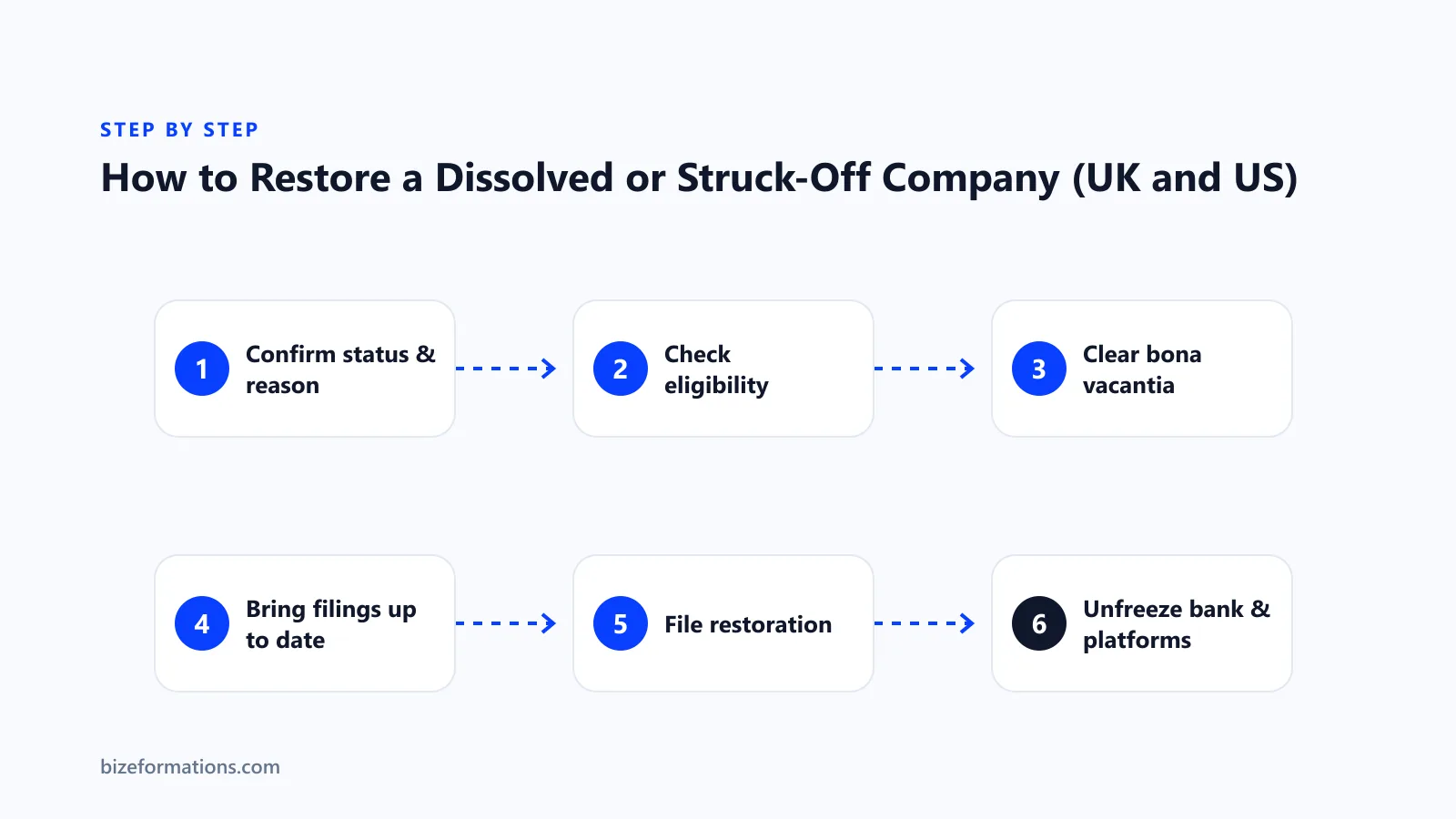
Route 1: UK administrative restoration
Administrative restoration is the faster, cheaper route, done directly with Companies House without going to court. You can use it if:
- the company was struck off by Companies House (not voluntarily dissolved by its directors);
- you apply within six years of the date of dissolution;
- you were a director or member of the company at the time it was struck off;
- the company was carrying on business or in operation when it was struck off.
What you need to do
- Get a waiver letter from Bona Vacantia if any assets (such as bank money) passed to the Crown. They'll confirm they don't object, and may charge costs.
- Bring all filings up to date: every overdue set of accounts and confirmation statement, filed together with the restoration application.
- Pay any outstanding late filing penalties that were due when the company was struck off.
- File the restoration application (form RT01) with the restoration fee, and a statement of compliance.
- Check the registered office is an appropriate address so the company doesn't fall straight back into the same problem.
Once Companies House approves the application, the company is restored and treated as though it had never been dissolved. Full details are on GOV.UK: restoring a company to the register.
Route 2: UK court restoration
If administrative restoration isn't available, for example because the company was voluntarily dissolved, you weren't a director, or more than six years have passed, you can apply to the court. Court restoration:
- can usually be made within six years of dissolution (longer in limited cases, such as personal injury claims);
- can be brought by former directors, members, creditors and others with a legitimate interest;
- requires a court application, notice to Companies House and the Treasury Solicitor, and usually costs more and takes longer;
- normally needs a solicitor.
Route 3: reinstating a dissolved US LLC or corporation
Each state has its own process, but the pattern is similar:
- Check the status on the Secretary of State's business search and note the dissolution date.
- Appoint or confirm a registered agent in the state. Reinstatement is refused without one.
- File all missing annual reports and pay overdue franchise taxes, fees and penalties.
- File the reinstatement application with the state fee. Some states, such as Florida, have a specific reinstatement form; others call it a "certificate of reinstatement" or "revival".
- Request a certificate of good standing once the state approves, to send to banks and payment platforms.
Time limits vary: some states allow reinstatement for years, others for a shorter window, after which you may have to form a new company. Federal IRS obligations, such as Form 5472 for foreign-owned LLCs, also need to be brought up to date.
Recovering frozen bank and payment funds
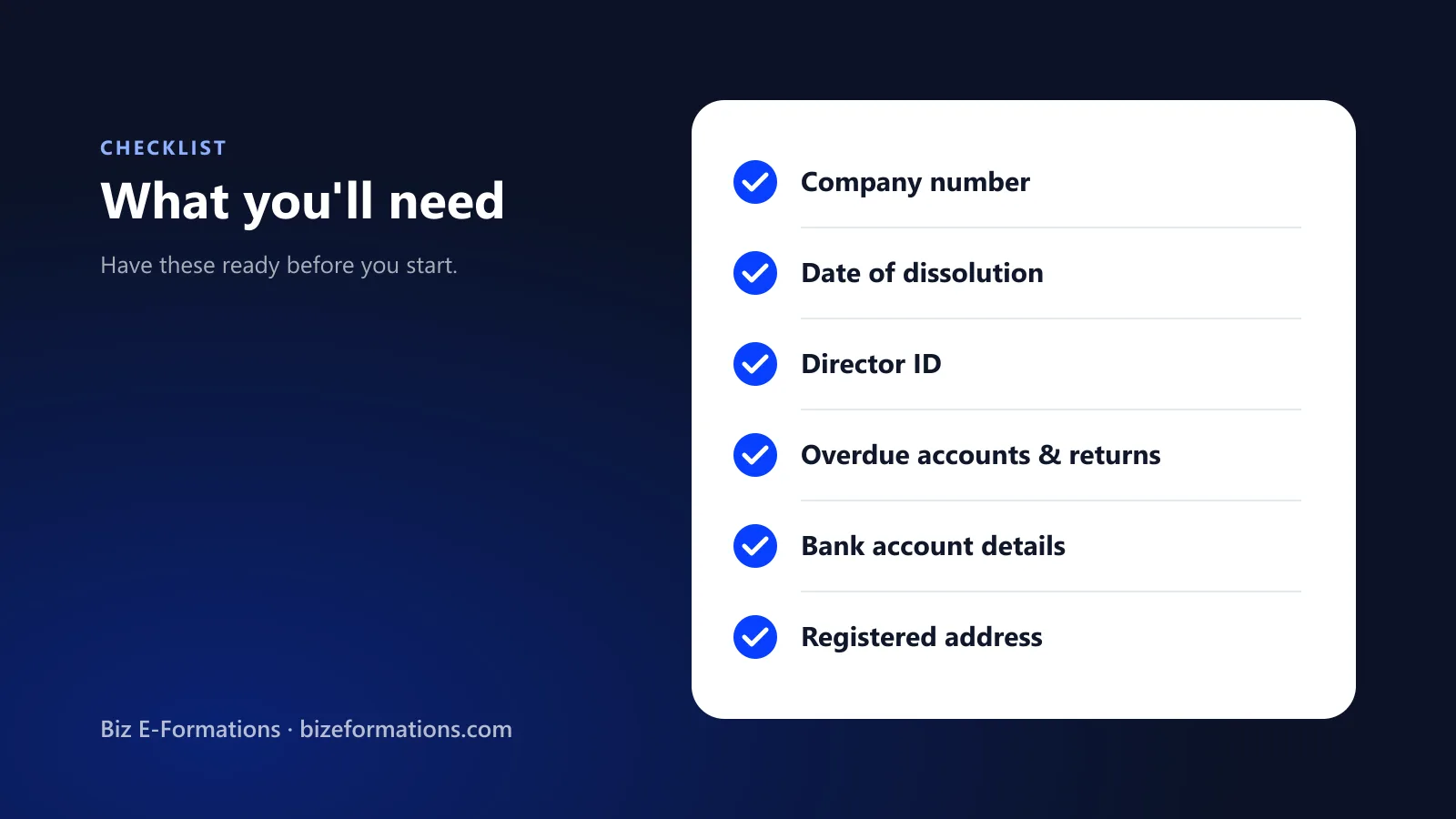
After restoration or reinstatement, contact each provider with proof that the company exists again:
- the Companies House record showing the company as active, or a US certificate of good standing;
- the restoration or reinstatement confirmation;
- photo ID and proof of address of the directors;
- recent invoices or contracts if they ask about the business.
Our step-by-step guide to unfreezing PayPal, Stripe, Wise and Payoneer funds covers each platform.
How long does restoration take?
| Route | Typical time |
|---|---|
| Suspending a strike-off notice | Days, once filings are made |
| UK administrative restoration | A few weeks, longer if a Bona Vacantia waiver is needed |
| UK court restoration | Several weeks to a few months |
| US state reinstatement | Days to a few weeks, depending on the state |
Common mistakes
- Opening a new company and moving the business. The old company's money and contracts stay with the dissolved company, and some platforms treat it as evasion.
- Ignoring strike-off notices. Acting at the notice stage is far cheaper than restoring later.
- Filing restoration without the overdue accounts. Applications are rejected if filings aren't complete.
- Keeping the same broken address. Fix the registered office or registered agent first.
- Waiting too long. The six-year limit for UK restoration is strict.
Why restore with Biz E-Formations?
- We confirm the right route (suspension, administrative, court or US reinstatement) before you spend anything.
- We prepare overdue accounts and returns, liaise with Bona Vacantia where needed, and file the restoration.
- We fix the root cause: a proper registered office or registered agent, plus deadline reminders in your portal.
- We help you go back to your bank and payment platforms with the right documents.
Conclusion
A dissolved company isn't necessarily the end. In the UK, administrative restoration within six years usually brings the company and its money back as if nothing had happened. In the US, state reinstatement does the same for LLCs and corporations. Act quickly, bring every filing up to date, and fix the address problem that caused it. Then reopen your accounts with proof of good standing.
Get in touch
Tell us your company number and what's happened. Send us a message, ask Biz AI on this page, or book a free 30-minute consultation.
